Grass or Clay: What a Tennis Court Surface Changes
Grass or clay tennis courts change bounce, movement, and rally rhythm. Learn what to expect from each surface and how players adapt their choices.
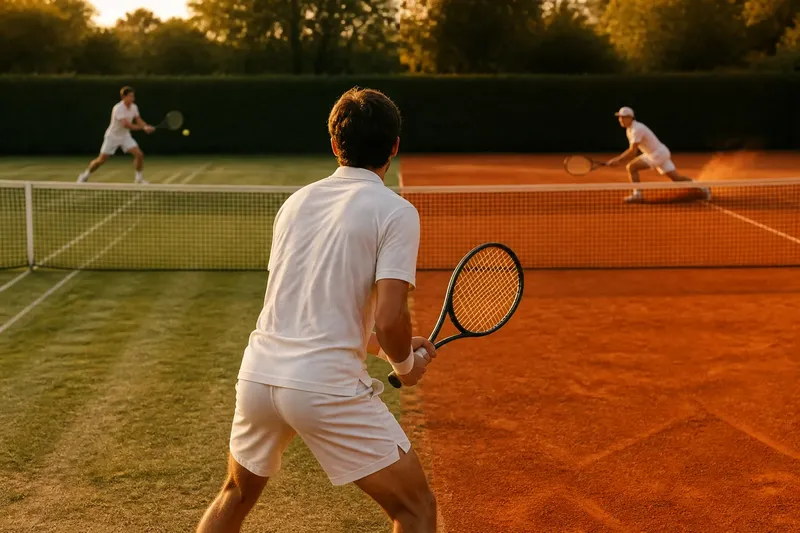
The common mistake on a grass or clay tennis court is to expect the same ball to arrive in the same way. It may cost a player a clean contact point, a balanced shot, or a rally plan that made sense on another surface. Grass and clay change the exchange from the first bounce onward.
How does a grass or clay tennis court change the bounce?
Grass usually produces a lower, quicker bounce than clay. The ball can skid through rather than rise comfortably into a player’s preferred hitting zone. The exact response varies with the court’s condition: a ball may behave differently across worn patches, and damp or dry grass can change how it grips.
Clay generally gives the ball more time in the air after it hits the surface and a higher bounce. The slower, more vertical response can push a player back or above a comfortable contact point. Clay is not one uniform material, either; its preparation and condition affect how the ball travels.
That difference shapes shot selection. On grass, a low ball can reward a compact response and an early contact, while a heavy topspin shot may be less troublesome if it does not kick high. On clay, topspin can help lift the ball over the net and make it jump after landing, forcing an opponent to adjust position and swing.
Why does movement feel different on each surface?
Grass tends to call for short, careful adjustments. Its footing may feel less predictable, particularly where play has worn the turf, so players often try to reach the ball in balance rather than make a long, late correction. Quick steps and a ready stance matter when the bounce stays low.
Clay allows a different kind of movement. Players can learn to slide into a shot, letting momentum carry them toward the ball while they prepare their stroke. That can help cover a wide angle, but a slide that begins too late or ends in the wrong position leaves little time to recover.
Neither surface removes movement demands; each changes their shape. Grass often rewards getting set early and keeping adjustments economical. Clay gives players more scope to defend from farther away, but the longer route back toward the center can become part of the next shot’s cost.
How does surface change the rhythm of a rally?
Grass often favors a faster exchange. A low bounce can make a return feel urgent, and players may look to serve, approach the net, or finish with a volley before the opponent settles. Shorter rallies are possible, though a quick court does not make every point short.
Clay tends to stretch the exchange. The higher bounce and slower pace can give both players time to retrieve and reset. A rally may become a sequence of changes in depth, height, and angle, with one player trying to move the other out of position before attempting a shorter ball or a finishing shot.
Think of the surface as a sloped floor under a rolling object: the same push produces a different route. The comparison is imperfect, but it captures why a player cannot rely on stroke alone. Bounce, footing, and recovery time shape what the next ball makes possible.
What do these differences mean for tactics?
On grass, players may favor a reliable serve, an early strike, and a willingness to move forward when a short reply appears. A low slice can keep the ball awkwardly close to the ground. A player who waits for a high, comfortable ball may spend the point reacting instead of choosing where to send it.
On clay, patience and depth can matter more. A player may use topspin to push an opponent behind the baseline, then change direction or bring that player forward. Defenders can use the extra time to return difficult balls, but simply keeping the rally going does not create an opening unless the ball’s placement changes the opponent’s position.
Say a player arrives expecting grass and finds a clay court. If they keep hitting flat shots at the same height and aim for immediate winners, the higher bounce may give the opponent time to reset. If they instead add more topspin, aim deeper, and allow time to recover after each shot, they can expect a more manageable rally pattern, even if it does not produce an instant advantage.
Which surface suits which style of player?
Grass may suit players comfortable with quick decisions, a dependable serve, and forward movement. A player with a strong volley can use a low bounce to approach behind a well-placed shot. But the surface can also trouble aggressive players when the ball stays too low or the footing disrupts their timing.
Clay may suit players who are happy to construct points, vary spin, and defend over repeated exchanges. It can give a patient player room to recover and use angles. Yet a player who relies on short, flat attacks may need to change the height or depth of those shots to keep an opponent from settling in.
Style is not destiny. A player’s movement, preferred contact height, shot tolerance, and experience on a surface all matter. A practice session on the actual court can reveal whether the bounce and footing fit a player’s habits better than a broad label such as “attacker” or “defender.”
What questions do players ask about grass and clay?
Is grass always faster than clay?
Grass is generally associated with a quicker, lower bounce, while clay typically slows the ball and sends it higher. Court condition and weather can alter the feel, so the surface name alone does not describe every point.
Why do players slide on clay?
The surface can allow a controlled slide that helps a player reach a wide ball while preparing a shot. Timing and balance still matter; sliding is a movement option, not a substitute for getting into position.
Does clay make rallies longer?
Clay often gives players more time to reach and return the ball, which can extend rallies. Point length still depends on serving, placement, tactics, and the players’ ability to finish an opening.
Can a player use the same racket and strings on both?
Many players keep the same equipment, but their preferred tension, grip, or string setup may depend on feel and playing style. The racket and string maker’s instructions apply to equipment choices; a knowledgeable racket technician can discuss adjustments suited to an individual player.
How should a player prepare for a change of surface?
Start by noticing where the ball reaches a comfortable contact point. In practice, try a few controlled exchanges with different heights and spins, then pay attention to how much time remains for recovery. On grass, rehearse compact reactions to low balls; on clay, practice moving into a slide only if it is already part of your movement skills.
Watch how the court itself is playing rather than assuming every patch behaves alike. Worn areas, moisture, and the way a clay court has been prepared can affect footing and bounce. For anyone choosing between grass and clay, the useful question is not which is better, but which set of demands makes for the more compelling game to play or watch.