Why a Basketball Backboard Is Wider Than the Target
Why a basketball backboard is wider than the target: understand its visual frame, useful rebound area, and the role each plays in a bank shot.
The common mistake is to treat the rim as the only useful part of a basketball goal. That misses why a basketball backboard is wider than the target: its clear area helps a shooter judge the rim’s position and gives certain shots a surface to use. Ignore that frame, and a bank shot can become guesswork rather than a deliberate choice.
What is the backboard for?
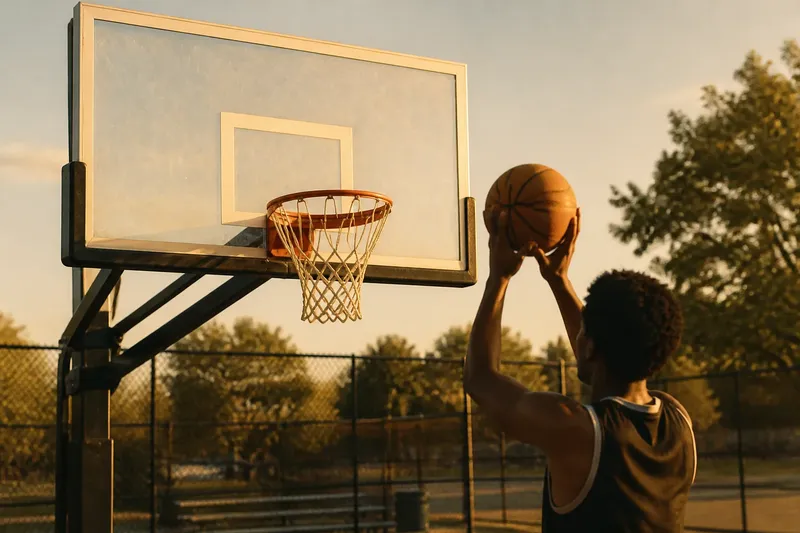
The hoop is the target. The backboard is the broad, rigid plane mounted behind it. It does not make the opening larger, and a ball that touches the board has not scored unless it then passes through the rim. The board supports the goal assembly and creates a consistent surface near the basket.
That distinction matters because players use the board in two different ways. They read it as a visual reference when aiming, and they intentionally send the ball against it on a bank shot. The same rectangle serves both purposes, but neither turns the board itself into a scoring target.
Think of the backboard as a picture frame around a small picture. The frame helps the eye locate the important part; it does not become the picture. The analogy has limits, since a basketball can rebound off the frame, but it captures the board’s supporting role.
Why is the board broader than the rim?
A shot approaches the basket from different angles, not just straight on. A broad board gives the player a useful aiming surface to the left and right of the rim, especially when moving toward the basket from a side lane. The rim remains the destination; the board offers more than one possible path to it.
The extra width also makes the board legible as a single object in play. Players can see its edges, the marked target area, and the rim in relation to one another. A narrow plate behind the hoop would provide less visual context and less room for a ball to meet the surface before reaching the basket.
That does not mean every shot should use the board. A direct shot can travel cleanly toward the rim without touching it. The board becomes useful when the player’s position and angle make a controlled rebound a sensible option.
What does the target rectangle tell a shooter?
Many backboards have a smaller rectangle painted or marked above the rim. It gives the eye a local reference near the hoop, rather than asking a shooter to aim at an entire transparent or solid panel. For a common bank shot from the side, the player can choose a point on the rectangle and send the ball toward it so the rebound carries the ball toward the rim.
The rectangle is a visual aid, not a second hoop. Its markings do not change where a basket counts, and the correct contact point shifts with the shooter’s position, release, and direction of travel. A player approaching from one side may use a different part of the marked area than someone coming from the other.
Imagine a player coming in from the right side of the lane with a defender closing the direct path. The player aims for a chosen spot on the board beside the rim, using the board to redirect the ball toward the basket. The expected observable result is a rebound that travels toward the hoop; contact with the board alone still earns no score.
How does the rebound surface change a shot?
A backboard rebound depends on where the ball meets the board and how it arrives. A contact point closer to the rim usually sends the ball on a different path from one farther away. The player’s approach angle matters too, which is why a spot that works from one side may not suit the same shot from the opposite side.
The surface makes the bank shot possible, but it does not make the result automatic. A ball can strike too hard, too far from the intended point, or at an unhelpful angle. Players learn to read the board through repetition and adjust their aim to the path they are taking, rather than treating the painted rectangle as a universal bull’s-eye.
Backboard material also affects what the rebound feels like. Glass, acrylic, and other approved materials can differ in stiffness and response, while the mounting and condition of the goal matter as well. For a player choosing a home or practice goal, the manufacturer’s specifications and installation instructions are the sensible place to check whether a particular board suits the intended use.
What should you notice when choosing a backboard?
For a player or facility comparing goals, width is only one part of the decision. The board needs to suit the space, the goal assembly, and the kind of play expected. A broad board can provide a familiar visual frame, but its usefulness depends on a stable, properly matched setup.
- Look at the playing space. Check how much room lies behind and beside the goal, so the board fits the court rather than crowding a wall or walkway.
- Check the material description. Compare the stated board material and its intended setting instead of assuming every hard surface rebounds the same way.
- Inspect the target markings. Confirm that the rectangle is clear enough to serve as a visual reference and is positioned in relation to the rim as intended by the maker.
- Consider visibility. A board should remain easy to read against its surroundings, including under the lighting where players will use it.
- Match the board to the goal assembly. Check compatibility with the rim and support, rather than treating the panel as a standalone part.
These checks concern fit and play, not a do-it-yourself construction plan. If installation involves a heavy goal, uncertain mounting, or a damaged support, use a qualified installer rather than improvising with fasteners or a wall that may not be suitable.
How do players use the board from different angles?
A bank shot is most useful when the player can predict a clear path from the release point to the chosen contact point and onward to the rim. From near the side of the basket, that route may be more natural than aiming directly through the opening. From farther out or nearly in front, a direct attempt may be the more sensible choice.
The board also helps players orient themselves while approaching at speed. The rim stays the scoring target, while the panel provides a stable reference behind it. That relationship can make a shot easier to read without requiring the player to aim at the center of the board or use the bank on every attempt.
For practice, it helps to notice the result rather than merely count makes. Was the contact point close to the intended mark? Did the rebound travel toward the rim, or away from it? Those observations give a player something specific to adjust without mistaking a lucky bounce for a reliable aim.
What do players ask about the backboard?
Can a ball score by hitting the backboard?
No. The ball must pass through the rim for a basket to count. A backboard touch can be part of the shot, but it is not a scoring event by itself.
Does a bank shot have to hit the painted rectangle?
No. A player can use other parts of the board, depending on position and angle. The rectangle is a convenient aiming reference, not a boundary for valid shots.
Why can a bank shot work from one side but not the other?
The ball reaches the board from a different direction, so the useful contact point and rebound path change. Aiming at the same place from both sides can send the ball away from the rim on one approach.
Is a larger backboard always better?
Not necessarily. A wider board may offer more visible frame and rebound area, but it still has to suit the goal assembly, space, and intended use. The hoop remains the target regardless of the panel’s size.
How should you read the board during play?
Start by separating the destination from the aid. Watch the rim to understand where the ball must go, then notice whether the board offers a useful route from the player’s position. That small distinction explains why the panel is broad without pretending the whole panel is a target.
For anyone searching why a basketball backboard is wider than the target, the short answer is that the board provides context and a rebound surface around the hoop. Its width supports shots from varied angles and helps players locate the rim, while the rim alone decides whether the ball scores. When watching a bank shot, follow the ball’s chosen contact point and its path off the board; the panel is part of the route, not the destination.