The Long Table Tennis Rally: From Parlour Game to Fast Contest
Table tennis history shows how repeatable tables, balls, and rules made longer rallies possible, while specialized paddles turned each return into a tactical choice.
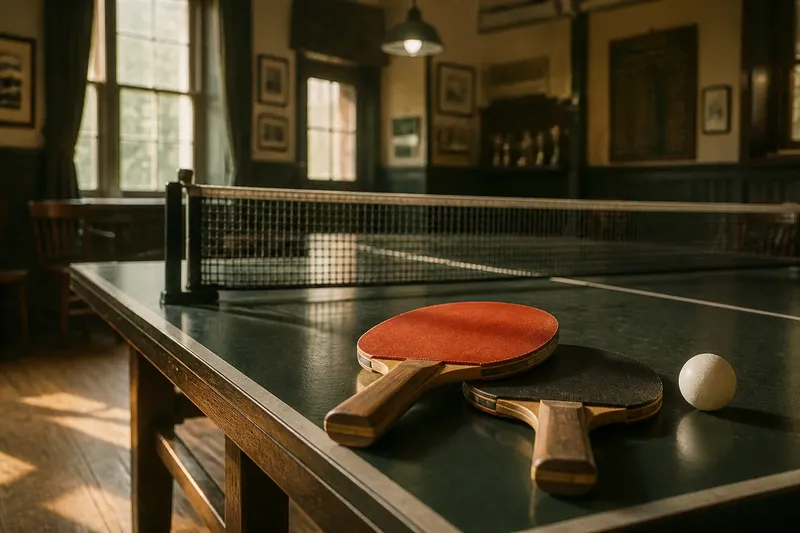
The common mistake in table tennis history is to credit faster equipment alone for turning a parlour amusement into a fast contest. A long rally depends just as much on a ball that rebounds predictably, room to reach it, and rules both players understand. Those conditions let a simple exchange become a test of control: one player sends the ball across, the other returns it, and neither can rely on a different table or homemade net to explain the outcome.
How did table tennis history begin at the dining table?
Indoor play offered a ready alternative to outdoor games. A dining table could serve as the playing surface, books or other household objects as a barrier, and improvised bats as striking tools. The arrangement made a quick game possible without a dedicated venue.
It also made rallies unpredictable for reasons unrelated to skill. Tables differed, barriers could sag or sit at different heights, and furniture crowded the space. A return that seemed easy in one room might be awkward in another. The game could be lively, but players lacked a shared standard for comparing a rally or a result.
That shift from pastime to sport was gradual, not a neat march from crude play to proper equipment. Domestic play remained a useful starting point, while clubs and makers developed more specialized arrangements. The important change was not that home play disappeared; it was that players began to make conditions repeatable enough for regular practice and competition.
What makes a long rally possible?
A long rally is not simply a sequence of hard shots. It asks both players to control pace, direction, and height well enough to keep the next return playable. A dependable table and ball help, but judgment matters too: the attacker must choose when to press, while the defender must find a return that buys time without handing over an easy finish.
Purpose-built equipment made those choices more varied. Bats developed from simple striking surfaces into paddles designed to give players more control over the ball. Rubber coverings made spin a more pronounced part of play: a serve or return could curve, dip, or kick differently after bouncing, so the opponent had to read the rotation as well as the direction.
Imagine two club players with plain wooden bats and a ball that bounces modestly. They switch to paddles with rubber surfaces, keeping the table and room unchanged. Their serves now produce more noticeable spin, so the receiver adjusts the angle of the bat; a return that once came back predictably may instead rise or drift. The visible result is a rally shaped by reading and adjustment, not merely by harder hitting.
Equipment did not make every rally longer. A new surface could support more controlled returns, but it could also make an attacking shot harder to handle. The point is that specialized paddles expanded the tactical conversation between strokes. Players could try to shorten the exchange with an attack or extend it by returning the ball safely and waiting for a better opening.
Why did balls and rules matter as much as paddles?
The ball’s material and construction affect its bounce and flight. Changes to its specification can alter how a rally feels, which is why a common ball matters when players want to practice or compete on comparable terms. The historical point is not that one material automatically made the game faster; it is that agreed equipment specifications reduced one source of uncertainty.
Rules supplied another shared reference. When players agree on how service, scoring, and the end of a point work, the rally becomes more than an informal exchange. A visiting player can join a match without first negotiating a household’s particular version of the game. Rules do not determine every style of play, but they make the contest legible beyond one room.
For a rally, that shared framework matters in a quiet way. Players can concentrate on whether the ball will clear the net and land on the table, rather than arguing over which improvised boundary counts. The ball, table, and rules act like the pieces of a familiar board game: once the basics stay put, attention can move to the decisions being made.
How did club rooms change the rally?
A dining room had other duties. Chairs, table edges, and the prospect of dinner limited movement and made repeated play awkward. A club room could be arranged around the table, leaving space for players to reach wide returns and for spectators to watch without standing in the path of the ball.
The room still shaped what players could do. A low ceiling could make a high defensive return impractical; close walls could cut off movement; uneven light could make a quick ball difficult to follow. Clubs had reason to favor clear floor space and a predictable setup, not because every venue had to be identical, but because comparable conditions made practice and matches easier to sustain.
A table is rather like a workbench: it can sit in a busy kitchen, but a clear surface makes repeated work less awkward. A dedicated room did not create skill. It made the conditions for practicing a rally more deliberate, and gave spectators a clearer view of the exchange.
What do readers ask about table tennis history?
Did table tennis start as a home game?
Domestic play was central to the pastime’s early appeal because a table and improvised equipment made indoor play convenient. Clubs and purpose-built gear later helped turn that adaptable amusement into more organized competition.
Why does spin affect a rally?
Spin changes how the ball behaves after it bounces and how it responds to a player’s stroke. The receiver must read that rotation and adjust the bat’s angle or the direction of the return.
Why did clubs need consistent equipment?
Consistent tables, nets, and balls gave players a more familiar basis for practice and matches. That made it easier to compare play across rooms instead of adapting to each household’s improvised setup.
Did specialized paddles make rallies longer?
They gave players more ways to control pace and spin, which could help sustain an exchange or create an opening to end it. Rally length still depended on the players’ choices, their skill, and the conditions in the room.
How can you see the change from pastime to contest?
Look at what a rally asks of its setting. In a home, players may accept a lopsided table or makeshift barrier because the point is to get a game going. In a club, those differences can frustrate practice and make a match harder to judge. Organized sport emerged through efforts to make the basic conditions more dependable, not through a single invention.
Equipment, rules, and space developed in relation to one another. A paddle that responds to spin makes a consistent ball more useful; a predictable table gives players a fairer place to practice that response; a room with space allows them to reach more returns. Each adjustment gives the rally more room to become a contest of choices rather than a negotiation with furniture.
That is the useful answer to what table tennis history says about the long rally. Its pleasure still lies in keeping the exchange alive, but the conditions around the table determine whether players can repeat it, study it, and test one another with some fairness. When a rally ends, the quality of the contest is often visible in the return that came just before it: chosen, read, and answered rather than left to a wobbly table or a chair in the way.