The Scoreboard Mistake: Treating Every Number as the Whole Story
A scoreboard shows the current score, not the whole contest. Learn how format, court markings, and equipment shape what a close number means.
The most common scoreboard mistake is to read the number without noticing the court, equipment, or rules that produced it. The same score can describe different contests when a boundary line, net, target, or scoring format changes what players can do. A display records outcomes; the playing environment helps explain them.
To interpret a score, identify its unit, then look for the material features that shape play. A tennis net and service lines divide the court into specific zones. A basketball rim and painted lane give certain shots and positions their meaning. These details are not decoration around the score. They are part of the game’s design.
What does the scoreboard actually count?
Before interpreting a number, work out what it represents. A display may show points in a period, games in a set, sets in a match, runs in an inning, or goals across two legs. Several totals can appear together, and the largest-looking one is not always the one that determines the immediate outcome.
Look for labels such as “period,” “set,” “game,” “inning,” “aggregate,” or “to serve.” If the screen is hard to read, listen for the official announcement or check the venue program. In a broadcast, a graphic may abbreviate the format because it has less room than the rules.
Then notice the clock or event marker. A score of one to zero early in a match and the same score near the end have the same arithmetic, but not the same context. The clock, completed inning, or final-set marker locates the number within the contest.
How do surfaces and equipment change the meaning?
Lines, nets, goals, and other equipment define legal spaces and available actions. On a tennis court, the service boxes and baselines tell you where a serve must land and when a ball is out. In basketball, the rim, backboard, and painted lane shape where attempts can be taken and how defenders position themselves. A scoreboard cannot show those constraints by itself.
Surface material also affects how play unfolds. A ball may move differently across a hard court, grass, or clay, while a running track’s marked lanes channel competitors into separate paths. These conditions can influence the sequence of scoring chances without changing the numbers already displayed. The score is like a receipt: precise about what was recorded, silent about how the goods reached the counter.
When watching, connect the score to the visible setup. Ask which lines govern the next play, what equipment must be used, and whether the surface changes the available choices. This keeps attention on observable features rather than treating a score as a complete explanation.
How does the format change the meaning?
Once you know the scoring unit, identify how the competition is decided. Some contests end when time expires. Others continue until a target is reached, a set is completed, or a prescribed number of turns has passed. A lead has different weight in each arrangement because the remaining opportunities differ.
In a timed game, the clock limits the number of chances to change the score. In a set-based match, the visible point total may matter less than whether a competitor is close to taking the set. In a tournament with multiple rounds or an aggregate total, today’s score may be only one part of the result.
Ask two plain questions: What ends this contest, and what still has to happen before it ends? Then add a third: which court feature or piece of equipment will govern the next meaningful action? Together, the answers clarify what a lead or deficit means without pretending to predict the result.
What should you watch after reading the number?
Watch the sequence and the conditions around it. A score records accumulated outcomes; the sequence shows how the contest has changed. Notice whether points come in clusters, whether a lead changes hands, or whether one side repeatedly answers the other. Then look at how players use the surface and equipment during those moments.
For instance, a tennis player’s serve may place the opponent under pressure because of its angle and the position of the service box. A basketball team may create a scoring chance by moving the ball toward the rim or opening space near the three-point line. The visible score tells you which outcomes counted; the court and equipment help explain the choices that led to them.
Sequence is not a forecast. It is a record of what has already happened. In tennis, a point score sits inside a game, which sits inside a set; knowing that a player is one point from taking a game gives the next rally a different context. In basketball, the score alongside the clock can show whether a possession is ordinary or urgent. In both cases, boundaries and equipment make the next action legible.
How can you read a scoreboard in order?
Use this routine when the display seems to tell an obvious story:
- Name the unit. Check whether the number refers to points, games, sets, runs, goals, or another unit; if unclear, use the display label or venue announcement before interpreting it.
- Find the boundary. Check the period, clock, inning, set, or round; if the marker is missing, wait for the next official update rather than guessing where the contest stands.
- Identify the format. Check whether time, a target, sets, or another rule ends play; if the format is unfamiliar, consult the event program or ask an official which condition decides the match.
- Locate the relevant surface feature. Check which line, net, goal, or marked zone governs the next action; if it is not visible, use the venue layout or follow the official’s ruling instead of assuming a boundary.
- Trace the recent sequence. Check how the score changed in the latest stretch; if the display does not show the sequence, attend to the next plays and avoid assigning a pattern you cannot observe.
- Find the next threshold. Check what point, game, period, or turn could change the contest; if no threshold is imminent, keep the current score as context rather than treating every play as decisive.
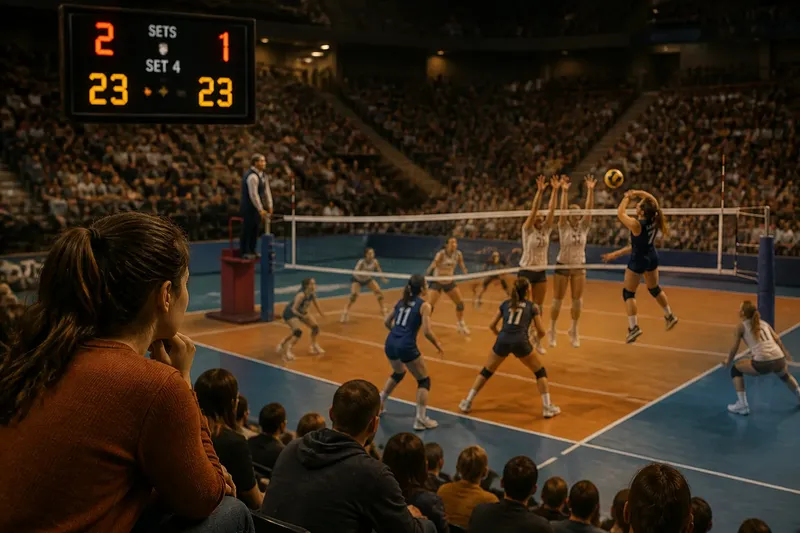
Say you arrive at an indoor volleyball match and see a display showing two sets to one, with the current set tied at twenty-three points. You identify sets and points as separate units, then check the event board and learn that the match is played as a best-of-five. The court’s attack line and net help you see where front-row players can attack and block; the score tells you that the next rallies may decide the set, not necessarily the match. You watch the next rally, see the serving team win the point, and update the display reading to a one-point lead. The result is a clearer account of the immediate stakes, without claiming to know how the set will end.
Which scoreboard questions help explain the court?
Why can a small lead still matter a lot?
Its importance depends on the format and remaining opportunities. A small lead near the end of a timed contest may be difficult to erase, while the same gap early in a match may be modest.
Why can the same score feel different on another surface?
Surface material affects how the ball or athlete moves, while the rules determine how those actions count. The score remains a record of outcomes, but the conditions that produced them may differ.
What does equipment add to a score?
Equipment defines actions and boundaries: a net separates sides, a rim marks a scoring target, and court lines identify legal zones. Seeing those features helps explain the options available before a point is recorded.
What if the format or markings are unfamiliar?
Check the event program or ask an informed official or attendant which unit decides the match and which lines govern play. Follow the posted rules and official decisions rather than assuming every sport uses the same convention.
How do you keep a first impression in check?
Separate what the display states from what you infer. “The score is tied” is an observation. “Neither side has had an advantage” may not follow: one competitor could have led for most of the contest, or the format could make the next point unusually consequential.
Notice what the scoreboard leaves out. It may not show possession, serve, substitutions, penalties, surface conditions, or the result needed elsewhere in a tournament. Track only the details that change your reading of the current score, then return your attention to the play.
To interpret a scoreboard, read the score, locate it in the format, and connect it to the court’s lines, surface, and equipment. That gives the number a useful context without asking it to explain every decision or movement.
One useful distinction remains: the scoreboard tells you what has been counted; the rules and playing setup tell you what can count next. Watch both, and the next point becomes easier to understand.