How Pool Design Shapes a Swimming Race
Pool design shapes a swimming race through wall spacing, lane layout, and visibility; learn how those choices change turns, tactics, and what spectators can see.
The common mistake is to treat a pool as a neutral container for a swimming race. That costs you the most revealing part of the design: how wall spacing, lane ropes, and sightlines shape a swimmer’s choices and a spectator’s view. Pool design changes the rhythm of a race before anyone touches the water.
How does pool length change race rhythm?
Pool length determines how often swimmers meet a wall. In a short-course pool, a given race includes more turns than it does in a long-course pool. Each turn interrupts steady swimming, creates an opportunity to push off, and changes how frequently the field compresses and spreads out.
A turn is not merely a break between lengths. Swimmers approach at speed, execute the turn required by their stroke, and push back into open water. A strong push-off can alter the visible gap, while the approach demands that swimmers judge distance without slowing unnecessarily. The wall acts less like a stop sign than a hinge in the race.
That difference also changes what spectators see. More turns mean more repeated moments of approach, contact, and acceleration. In a longer pool, swimmers spend more of the race traveling between walls, so the continuous pace is easier to observe and the turning moments are less frequent.
What do lane ropes and lane assignments actually do?
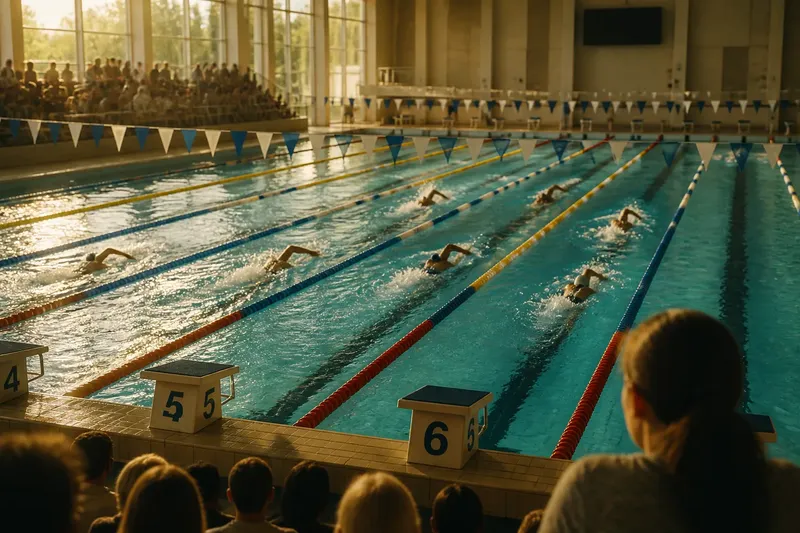
Lane ropes divide the water into parallel paths and reduce the waves that travel between swimmers. They help keep each swimmer’s course distinct, but they do not make the lanes identical in every practical respect. Water movement, the swimmer’s position, and the viewing angle can all affect what appears to be happening.
Lane assignments are made under the meet’s rules, often using prior times to place competitors. The exact procedure can differ by meet and round. A central lane is not a built-in advantage or proof that its swimmer is leading; it is one position in a pool whose lanes serve mainly to organize the field.
Lane ropes are also part of the visual design. Their color changes can mark distance from a wall, while lane numbers identify each swimmer’s route. Those cues make the pool legible without requiring a spectator to track every stroke. They function like dividers in a file drawer: useful for keeping things in order, not evidence that one compartment contains better material.
Why can a pool look different from the swimmer’s perspective?
From the stands, a swimmer’s apparent position depends on the angle of view. A diagonal seat can make one lane seem farther ahead than another, even when the swimmers are close. Reflections and surface waves can obscure a hand or a turn, especially when several lanes reach a wall together.
For swimmers, the pool’s markings provide practical visual references. Lane ropes guide direction, floor markings indicate the approach to the wall, and flags above the water alert backstroke swimmers that the wall is near. These features reduce the need to lift the head or guess at the remaining distance.
The same markings serve different purposes for people watching. Floor lines can help compare progress when swimmers cross a shared point, while backstroke flags explain why a swimmer changes stroke timing before reaching the end. Pool design is doing quiet work for both groups, though not always in the same way.
How do pool features change a race?
Pool features influence the conditions of competition, but they do not determine a result by themselves. The number and spacing of turns affect pacing decisions. A swimmer who is comfortable maintaining speed into a wall may handle a short-course race differently from one that relies on long stretches of uninterrupted swimming.
The design also shapes how race action is distributed. Turns create repeated points where swimmers can gain or lose ground, while long stretches give more room for differences in stroke rhythm and sustained speed to become visible. In either format, the finish still depends on reaching the designated wall and making a legal touch.
Imagine a hypothetical meet where the same event is held first in a short-course pool and later in a long-course pool. A swimmer who turns sharply and pushes off strongly may appear more prominent in the first race because the wall returns often. In the second, the observable difference is a longer uninterrupted stretch between turns; the comparison says something about race demands, not which pool is inherently fairer or faster.
What do spectators ask about pool design?
Is a short-course pool always faster?
Not as a general rule for every swimmer or race. More turns create more chances to use a push-off, but they also require repeated approaches and legal turns.
Why are backstroke flags placed over the pool?
They give backstroke swimmers a visual cue that the wall is approaching. That helps them prepare their final strokes and turn without looking toward the end.
Do lane ropes stop waves completely?
No. They reduce the spread of waves between lanes, but water still moves. The ropes help limit interference rather than create perfectly still lanes.
Why do some lanes look faster from the stands?
Viewing angle, reflections, and the observer’s position can distort apparent progress. Compare swimmers at a shared point or wait for the official result instead of treating perspective as a timing device.
What should you compare when looking at two pools?
- Observe wall spacing: If the event includes frequent turns, then expect repeated changes in pace; if swimmers spend long stretches between walls, then focus on sustained movement instead.
- Observe lane markings: If numbers and floor lines are easy to distinguish, then use them to identify routes and wall approaches; if they are hard to see, then rely on lane ropes and the starting blocks.
- Observe backstroke flags: If flags cross the pool near the ends, then watch how they cue the approach; if they are absent from your view, then use the swimmer’s position relative to the wall rather than guessing from stroke timing.
- Observe the seat’s angle: If you can see along the lanes, then compare swimmers at a shared wall or marking; if your view is diagonal, then avoid judging a close lead by apparent distance alone.
- Observe reflections and surface chop: If hands and turns remain visible, then follow the movement directly; if glare obscures them, then shift attention to the lane ropes and the order swimmers reach the wall.
- Observe where the start and finish are located: If both ends are visible, then note how the course is oriented; if one end is blocked, then use the event announcement and pool markings to understand which wall completes the race.
Pool design shapes a swimming race through the interaction of distance, turns, and visibility. Noticing those choices gives the event a clearer structure: walls create turning points, lane ropes organize movement, and markings help swimmers and spectators read the water. The useful distinction is between what the pool makes possible and what a swimmer chooses to do with it.